Learning to do things independently is an important part of early childhood development. For toddlers and preschoolers with autism, everyday self-help skills such as getting dressed, washing hands, using utensils or helping clean up may require additional teaching, practice and patience.
These may seem like small tasks, but each new skill can help a child become more independent and confident while making everyday routines easier for the entire family.
At Phoenix Autism Center, developing functional skills is an important part of helping young children build abilities they can use at home, at school and throughout their daily lives.
What Are Self-Help Skills?
Self-help skills are everyday tasks that allow children to participate more independently in their own care and routines. Depending on a child’s age and individual development, these can include:
- Feeding themselves with a spoon or fork
- Drinking from an open cup
- Washing and drying their hands
- Brushing their teeth
- Helping put on or remove clothing
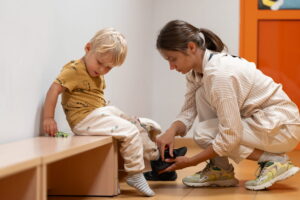
- Putting shoes on
- Participating in toileting routines
- Putting toys away
- Carrying belongings to the appropriate place
- Helping with simple household tasks
Independence doesn’t mean a young child needs to complete these activities perfectly or without any assistance. The goal is to help the child gradually participate in more steps of the activity as their skills develop.
The CDC encourages parents of young children to provide opportunities for growing independence, including helping with dressing, feeding themselves and simple chores.
Why Self-Help Skills Can Be Challenging for Children with Autism
Many everyday routines actually involve several different skills working together.
Getting dressed, for example, may require a child to follow a sequence, coordinate movements, tolerate the feeling of different fabrics, understand verbal directions and remain engaged until the task is finished.
For a child with autism, challenges involving communication, motor skills, sensory processing, attention or transitions can make some of these routines more difficult.
That’s why it can be helpful to look at the individual steps involved rather than focusing only on the finished task.
“When we work on independence with young children, we aren’t expecting them to suddenly do everything on their own. We look at what they can already do and build from there. Even learning one new step of a daily routine can be meaningful progress.”
— Bre Hartman, Co-Founder, Phoenix Autism Center
Break Bigger Tasks Into Smaller Steps
One of the most effective ways to teach a new self-help skill is to break it into smaller, manageable steps.
Consider handwashing. Instead of treating “wash your hands” as one skill, it can be separated into several actions:
Turn on the water. Wet hands. Get soap. Rub hands together. Rinse. Turn off the water. Dry hands.
A child may initially need help with most of those steps. Over time, they may begin completing one or two independently and gradually learn the rest.
This approach allows families and therapists to recognize progress that might otherwise be overlooked.
Practice During Everyday Routines
Self-help skills don’t always require a separate “learning” activity. Some of the best opportunities happen naturally throughout the day.
A child can practice putting clothing in the hamper while getting ready for a bath. They can carry their plate to the counter after eating. They can help put toys into a bin before moving to another activity.
These everyday moments give children repeated opportunities to practice a skill in the environment where they will actually use it.
Consistent routines can be especially helpful. The CDC notes that predictable routines help young children know what to expect and recommends incorporating activities such as getting dressed, brushing teeth and simple chores into regular routines.
Give Your Child Time to Try
When you’re trying to get out the door in the morning, it can be much faster to put on your child’s shoes yourself. But when time allows, giving a child an opportunity to attempt part of the task can help build independence.
Parents can start with a step the child can reasonably accomplish and provide help when needed.
For example, you might place a shirt over your child’s head but encourage them to push their arms through the sleeves. Or you might scoop food onto a spoon and allow your child to bring the spoon to their mouth.
As skills improve, assistance can gradually be reduced.
Celebrate Progress, Not Perfection
Self-help skills develop over time, and progress may look different for every child.
A child who previously needed complete assistance getting dressed may begin pulling up their own pants. Another may learn to place their cup in the sink. Another may begin tolerating toothbrushing for longer periods.
Those are meaningful accomplishments.
Positive attention and encouragement can help children understand which behaviors and skills are being reinforced. Keeping expectations appropriate for the child’s current abilities can also make learning less frustrating for both the child and the family.
How Therapy Can Support Greater Independence
For children with autism, self-help skills can be incorporated into therapy based on the child’s individual needs and goals.
ABA therapy can help teach routines by breaking skills into manageable steps, providing appropriate prompts and reinforcing progress. Occupational therapy may address underlying fine-motor, sensory or coordination skills involved in activities such as dressing, feeding and grooming. Speech therapy can support the communication skills children need to request help, make choices and participate more successfully in everyday routines.
At Phoenix Autism Center, our multidisciplinary approach allows our team to consider how these different areas of development work together.
Building Skills for Everyday Life
Helping a young child become more independent isn’t about rushing development or comparing their abilities with those of other children. It’s about identifying skills that can make everyday life easier and giving the child appropriate opportunities to learn them.
Small accomplishments add up. Putting away a toy, taking off a jacket or washing hands with less assistance may seem simple, but each represents another step toward greater independence.
Phoenix Autism Center provides center-based ABA therapy, speech therapy, occupational therapy and other services designed to support the developmental needs of young children with autism. Our team works with families to help children build practical skills they can use across everyday environments.
Help Your Child Build Skills for Greater Independence
Every new skill can make a meaningful difference in your child’s daily life. At Phoenix Autism Center, our team works with children and families to build practical skills that support greater independence, confidence and participation in everyday routines. If you’d like to learn more about our ABA, speech and occupational therapy services or discuss your child’s needs, contact Phoenix Autism Center today.