
When a child begins autism therapy, families naturally look for progress. A new word, an easier transition, more successful play with another child or greater independence with a daily routine can feel like an important breakthrough.
Then, sometimes, progress seems to slow down.
A child who was quickly gaining new skills may appear to stay in the same place for several weeks. At another point, several new abilities may seem to emerge almost at once.
For parents, these changes in pace can be confusing. But development doesn’t always happen in a steady, predictable line. Children with autism can have very different abilities across communication, social interaction, learning, movement and daily living skills, and those abilities can change over time.
Understanding that progress can come in waves can help families recognize growth that may be happening even when the next big milestone hasn’t appeared yet.
Progress Doesn’t Always Look Like a Straight Line
It’s easy to picture learning as a staircase: a child learns one skill, masters it and immediately moves on to the next.
In reality, development can be much less orderly.
A child might make noticeable progress in communication while a self-help skill takes longer. Another child might spend weeks practicing a skill before suddenly beginning to use it more independently.
Sometimes the progress is subtle.
A child learning to request an item, for example, might first need significant prompting. Later, they may need only a small reminder. Eventually, they may request the item independently.
From the outside, it might seem like the child spent weeks learning the “same” skill. From a developmental perspective, however, important changes were happening along the way.
What Looks Like a Plateau May Still Include Progress
When a child isn’t demonstrating an obvious new skill, parents may worry that development has stopped.
But a period without a major new milestone doesn’t necessarily mean nothing is changing.
A child may be strengthening a skill they recently learned, becoming more consistent with it or learning to use it in different situations.
Consider a child who has learned to ask for “water” during therapy. The next step isn’t necessarily learning another word. Progress might involve requesting water at home, asking a different adult, using the word without being prompted or communicating the request when their usual cup isn’t available.
This ability to use a learned skill across different people, settings and situations is called generalization, and it is an important part of making skills useful in everyday life.
Sometimes Several Skills Have to Come Together
Many of the abilities we think of as a single milestone actually depend on several smaller skills.
Playing successfully with another child might require communication, attention, turn-taking, waiting, flexibility and emotional regulation.
Getting dressed independently might require fine motor skills, following a sequence, tolerating different textures and knowing when to ask for help.
A child may be developing several of those underlying abilities before the larger skill becomes visible.
That can create moments when progress suddenly seems to accelerate. What looks like an overnight breakthrough may actually reflect weeks or months of smaller skills beginning to work together.
Different Areas Can Develop at Different Speeds
Autism affects each child differently. The CDC notes that the abilities of people with autism can vary significantly and that people with autism may have different ways of learning, moving or paying attention.
That means progress may not happen equally across every developmental area.
A child might make significant gains in:
- Functional communication
- Following directions
- Social interaction
- Fine motor abilities
- Self-help skills
- Emotional regulation
- Play skills
- Transitions and routines
One area may move forward quickly while another requires much more time and support.
This is one reason individualized goals are so important. Progress should be evaluated based on the child’s own needs, abilities and starting point rather than by comparing their development with another child’s.
New Skills Need Time to Become Reliable Skills
Doing something successfully once isn’t the same as fully mastering it.
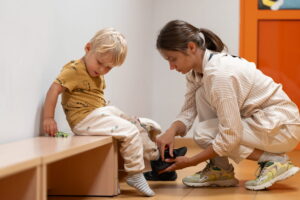
Imagine a child independently putting on their shoes for the first time. That’s exciting progress, but they may still need help the next morning.
With continued practice, they may begin doing it independently more often. Eventually, the skill may become part of their normal routine.
Communication and social skills can develop in a similar way.
A child may use a new phrase one day but not use it again for several days. They may successfully take turns during one activity but struggle with another.
Repeated practice helps new abilities become more consistent and useful across everyday situations.
Therapy Progress Should Be Measured Over Time
Looking only at what happened today—or even this week—may not provide the clearest picture of a child’s development.
One advantage of structured therapy is that progress can be tracked over time.
The CDC notes that Applied Behavior Analysis (ABA) uses measurement and tracking of progress while working to improve a variety of skills.
Data can help a therapy team see changes that may be difficult to recognize from individual sessions. It can also help identify when a strategy needs to be adjusted or when a child is ready for a new goal.
At Phoenix Autism Center, this individualized approach allows the team to respond to each child’s progress rather than expecting every child to develop according to the same schedule.
A Plateau Is Different From Losing Skills
There is an important distinction between progress slowing down and a child actually losing abilities they previously had.
If a child stops using skills they had consistently demonstrated—particularly communication, social or motor skills—parents should discuss that change with their child’s healthcare provider.
The CDC specifically recommends acting early if a child is not meeting developmental milestones or has lost skills they once had.
Developmental monitoring can help families and professionals recognize these changes and determine whether additional screening or evaluation may be appropriate.
Look Back Before Deciding Progress Has Stopped
When families are focused on the next goal, it can be easy to forget how far a child has already come.
Every few months, it can be helpful to think back.
What required help three months ago that your child can now do with less assistance?
Are transitions easier?
Is your child communicating wants or needs more clearly?
Are there fewer prompts needed during familiar routines?
Can your child participate in an activity for longer?
Are they using a skill with more people or in more places?
The answers may reveal progress that isn’t obvious from one day to the next.
Supporting Progress Through Different Seasons of Development
There will likely be times when development feels exciting and fast-moving and other times when progress feels slower.
Neither period tells the entire story.
The goal isn’t constant, dramatic improvement. It’s helping a child build meaningful skills, strengthen those skills and learn to use them in everyday life.
Early intervention can help children develop important abilities, and the CDC emphasizes that services and treatment plans should be individualized to each child’s needs.
By looking at development over time—and recognizing the smaller steps between major milestones—families can gain a clearer picture of the progress their child is making.
Help Your Child Keep Building on Their Progress
Every child’s developmental journey looks different, and progress may happen in big breakthroughs, small steps and everything in between. At Phoenix Autism Center, our team develops individualized goals designed to help children build meaningful skills in communication, social interaction, daily routines and greater independence. If you’d like to learn more about our ABA, speech and occupational therapy services or discuss your child’s needs, contact Phoenix Autism Center today.